


MathTango: Math Games for Kids
Play Piknik
MathTango: Math Games for Kids is the kind of educational game I would show to a child who already enjoys bright characters, small challenges, and the satisfaction of collecting progress. It is made by Play Piknik and sits in the educational game category, with activities aimed at children from kindergarten through grade five. My first impression is that it tries to make arithmetic feel like play rather than a worksheet, while still keeping the learning purpose visible.
The game is free to start and is rated for Everyone, which makes it easy for a parent to consider for a shared family device. It has reached over 100 thousand installs and holds a 4.5 average from around 600 ratings, so it has attracted a meaningful audience without feeling like an enormous, anonymous platform. I found that useful context: this is a focused children’s math title, not a general entertainment game with a small educational section attached.
How MathTango turns practice into a playful world
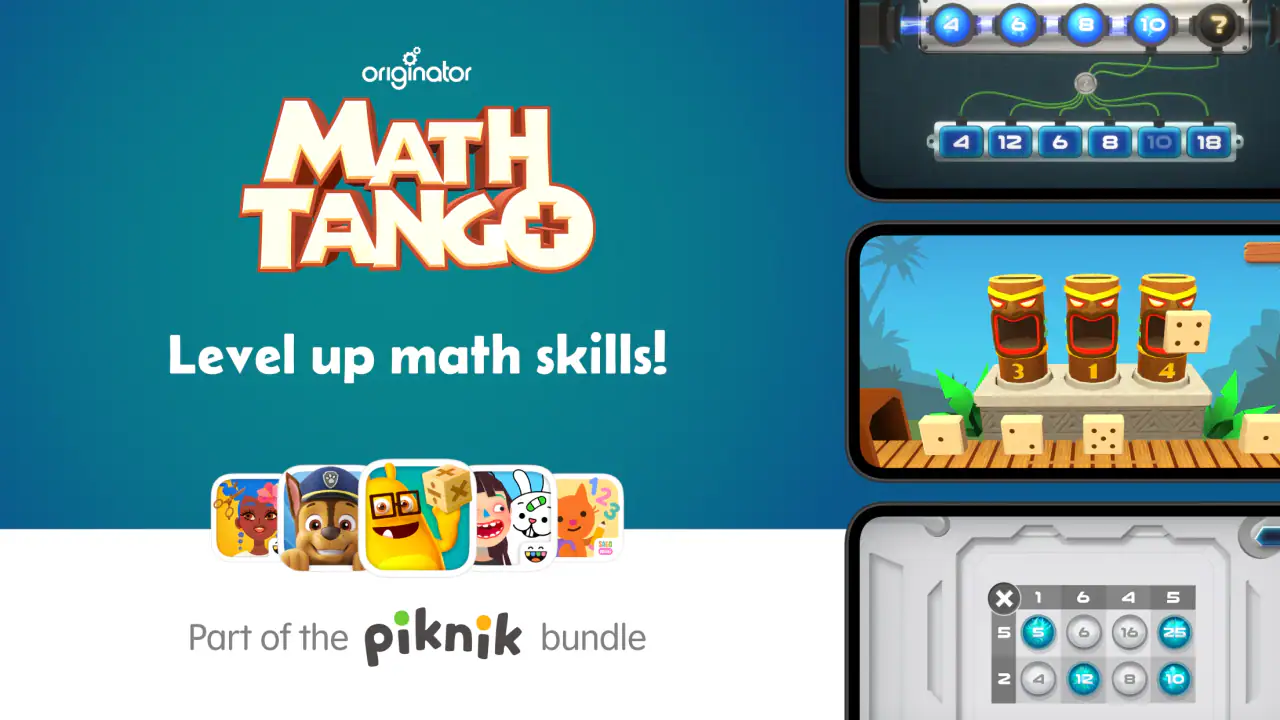
The strongest part of the presentation is its attempt to give number work a setting and a mood. Instead of asking a child to stare at a sequence of bare equations, the game frames practice around friendly monster-themed play. That choice matters because young learners often respond better when a task has a visible purpose, a character, or a small sense of discovery attached to it.
I like that the visual language does not appear to be aimed at making mathematics look intimidating. The monsters and colorful presentation create a softer entry point, especially for a child who becomes discouraged by traditional homework. The art direction gives the exercises an identity, but the numbers still need to remain readable. In an educational game, decoration is helpful only when it supports attention rather than competes with it.
That balance is one of the details I would watch during a child’s first sessions. Some children will use the characters as motivation and quickly understand that the activity underneath is math practice. Others may focus on the visual rewards and rush through the actual questions. I would sit with a younger player at first, not to control every answer, but to see whether the game’s world is helping them think or simply distracting them.
Related News






The kindergarten-to-grade-five range is broad. A beginner working on early counting needs a very different level of explanation from an older elementary student practicing more advanced arithmetic. MathTango is therefore best viewed as a family-oriented learning space with different entry points, rather than a single fixed course that will suit every child equally well. Parents should pay attention to whether the challenge feels appropriately demanding for their child.
For a child who needs confidence, the playful setting can make repetition less emotionally heavy. A wrong answer in a colorful game may feel easier to recover from than a red mark on a page. That does not replace careful teaching, but it can make short practice sessions more approachable. I see the game working especially well as a bridge between schoolwork and free time, when a child needs extra exposure without feeling that another formal lesson has begun.
A useful first-session routine
My preferred way to introduce it would be a short, supervised session after school. I would let the child explore the presentation first, then ask them to explain what kind of math each activity is asking them to do. That simple conversation reveals whether the game is teaching a method or merely inviting quick tapping. Afterward, I would ask which questions felt easy, which felt confusing, and whether the monsters made the activity more enjoyable.
Gallery
This approach also prevents a common problem with children’s learning apps: treating screen time as automatically productive. MathTango can support practice, but the child still benefits from talking through an answer. If a child repeatedly guesses, I would pause the game and work out one example with real objects, drawings, or spoken steps before continuing.
Another practical use is a short warm-up before homework. A few minutes of game-based arithmetic can help a child switch into number-thinking mode, especially after a long day. I would not use it as a reward that replaces all other practice, though. Writing numbers, explaining reasoning aloud, and solving unfamiliar problems on paper remain important because a game can make recognition easier than independent transfer.
Visual design that supports mood without replacing mechanics
The monster theme gives the game a coherent emotional direction: friendly, energetic, and less formal than a textbook. That tone is a good match for younger learners. The presentation suggests that math is something to enter and explore, not merely a test to survive.
Still, the real measure is whether the child can connect the playful action to the underlying skill. I would look for signs such as slowing down before answering, correcting a mistake, or explaining why an answer is right. Those behaviors matter more than whether the child remembers a character or wants to replay a visual sequence. The best outcome is when the setting lowers resistance and the mechanics build understanding.
Compared with a plain flashcard app, this game has a clear advantage in emotional engagement. Flashcards can be efficient, but they often feel repetitive and expose whether a child is already comfortable with drills. MathTango’s themed approach may keep a reluctant learner involved longer. The trade-off is that a simple drill tool can be faster for a parent who wants to check a specific fact or measure quick recall without any surrounding game context.
Sound, pacing, and the feeling of a session
Sound is especially important in a children’s game because it tells the player when an action has worked, when a mistake needs attention, and when a session is moving forward. In MathTango, the overall presentation is designed to feel active rather than classroom-still. That can help maintain momentum, but it also means parents should consider where and when the game is being used.
I would choose a quiet volume for a shared room and keep the first session short enough to observe whether audio cues help concentration. Some children use sound as useful feedback; others become more interested in repeated effects than in the question itself. If a child starts waiting for the response instead of thinking through the problem, lowering the volume or taking a brief pause can restore the focus on math.
The pacing also affects how much learning takes place. Fast transitions can make a game feel rewarding, yet speed is not the same as mastery. A child may become good at reacting to familiar formats without being ready to solve a differently worded problem. I would encourage deliberate answers rather than racing, particularly for children who tend to guess when a game feels timed or highly energetic.
That is where an adult can add value without turning the experience into a lecture. After a few questions, ask the child to describe the strategy they used. If they counted, grouped, compared, or recalled a fact, naming that process helps connect the game’s rhythm to actual mathematical thinking. It also shows whether the apparent success is based on understanding or lucky tapping.
For travel or waiting-room use, the game’s compact, self-contained style could be appealing. A child can have a constructive activity during a short idle period without carrying workbooks. I would avoid using it when the child is already overtired, however. Bright visuals and lively feedback can keep a tired child engaged past the point where learning is effective, creating the impression of progress while attention is fading.
Where the game mechanics fit best
The central design decision is to make math practice feel like a game. That works best for repetition, confidence-building, and regular exposure. If a child knows how to add but needs more comfortable practice, a themed activity can provide a gentler way to revisit the skill. It may also help a child who understands concepts in conversation but hesitates when faced with a line of exercises.
The game is less likely to be the complete answer for a child who needs a detailed explanation of a difficult concept. A digital activity can present questions and feedback, but it cannot always diagnose why a learner is confused. If subtraction with regrouping, place value, fractions, or another topic is causing persistent trouble, I would pair the game with a teacher’s explanation or hands-on practice rather than expecting repeated play to solve the issue.
That distinction is important when considering the wide school-age range. A kindergartener may benefit from playful number encounters, while an older elementary student may need more explicit reasoning, written work, and multi-step problems. MathTango can be a useful part of the routine, but I would not treat it as a replacement for the child’s full math curriculum.
One non-obvious strength is how it can make a parent’s observation easier. When a child is playing, you can notice whether the difficulty comes from calculation, reading the prompt, remembering instructions, or losing focus. Those are different problems, and the right support changes depending on which one appears. A child who answers slowly but accurately may need confidence; a child who answers quickly and inconsistently may need to slow down and explain.
Another useful workflow is to use the game before introducing paper practice, then return to the same type of problem away from the screen. If the child succeeds digitally but struggles on paper, the issue may be transfer rather than arithmetic. That comparison gives parents better information than relying on a game session alone. It turns the app into an observation tool as well as a practice activity.
I would also avoid presenting the game as a test. Praise the process instead of the score or speed: noticing a pattern, checking an answer, or trying again after a mistake. This keeps the playful atmosphere intact and reduces the risk that a child begins to associate math with performance pressure.
Free access and the purchase decision
The game is listed as free, with in-app purchases ranging from $7.99 to $79.99 per item. That makes the initial download easy to try, but the possible purchase range deserves a parent’s attention before handing over the device. I would explore the free experience first, decide whether the child actually enjoys the learning style, and only then consider whether additional access is worthwhile.
The highest-priced option is not automatically good value for every family. A child who plays occasionally may get enough from a limited experience, while a family using the game as a regular supplement may judge expanded content differently. The right question is not simply how much material exists, but whether the child is practicing the skills they genuinely need and whether the game remains a positive part of the routine.
For younger children, I would handle purchases myself and make the boundary clear: the game is for learning first, and new content is not guaranteed just because a child asks for it. This is also a good opportunity to explain that digital rewards and educational progress are separate things. The child should feel successful because they understand more, not only because something new becomes available.
Version 1.3 shows that the app has an identifiable current build, and it runs on devices using Android 5.1 or later. That broad compatibility is helpful for families using an older tablet, although performance and screen size can still affect comfort. On a small phone, a child may have less room to read and tap accurately than on a larger tablet. I would test the layout with the actual child using the device rather than assuming compatibility guarantees a good experience.
Who should choose it, and who should look elsewhere
I would recommend MathTango to parents seeking a friendly way to add math practice to a child’s day, especially when worksheets produce immediate resistance. It is also a reasonable option for families who want one game that can introduce younger learners to numbers while offering a path toward elementary-school practice. The monster setting gives the experience more personality than a bare drill sheet.
I would be more cautious if the child dislikes game-like rewards, becomes overstimulated by colorful presentation, or needs slow, step-by-step instruction. In those cases, a calm workbook, a whiteboard lesson, manipulatives, or a teacher-led app may be a better fit. Children who already have strong arithmetic fluency may also prefer a focused practice tool that gets directly to challenging problems without a playful layer.
It is not the best choice for a parent looking for a complete progress-reporting system, a substitute teacher, or a single solution for every math topic. Its value is more specific: it makes repeated practice feel approachable and gives children a themed space in which to engage with arithmetic. That is useful, but it should be placed alongside conversation, writing, and real-world problem solving.
Compared with educational videos, MathTango has the advantage of asking the child to respond rather than simply watch. Compared with paper worksheets, it offers more immediate atmosphere and feedback. Compared with a general puzzle game, its purpose is clearer because the math remains central. The compromise is that none of these formats alone covers every learning need, and the more playful the presentation becomes, the more actively an adult may need to check that the child is thinking.
My final view of the atmosphere and learning value
What stays with me is the coherence between the monster-themed art direction and the game’s educational purpose. The setting gives children a reason to enter the activity, the sound and pacing can make short practice feel lively, and the mechanics keep the focus on numbers rather than turning the app into a purely decorative experience. That combination is the game’s main appeal.
My advice is to use it in small, intentional sessions. Sit nearby at the beginning, ask the child to explain a solution occasionally, and follow digital practice with one or two questions in everyday life: sharing snacks, counting objects, comparing quantities, or checking change. Those simple connections reveal whether the game is building usable confidence rather than only encouraging quick answers.
Play Piknik has made a free educational game with a clear audience and an inviting mood. The 4.5 average from roughly 600 ratings is encouraging, but my recommendation would still depend on the child’s age, attention style, and current math needs. MathTango is at its best as a cheerful practice companion, not as a replacement for teaching. If that is the role you want, it is worth trying; if you need deep explanations or formal assessment, choose a more structured alternative and let this game serve as a lighter supplement.
FAQs for MathTango: Math Games for Kids
What is MathTango: Math Games for Kids?
MathTango is an educational mathematics app designed to help young children practice essential skills through interactive games, puzzles, and guided activities. Instead of presenting lessons as traditional worksheets, it uses a playful island-building adventure where children solve math problems to complete challenges and unlock content. The app generally focuses on foundational topics such as counting, addition, subtraction, place value, and early multiplication, depending on the child’s level.
What age group and math skills are suitable for MathTango?
MathTango is primarily aimed at elementary-school children who are developing their basic arithmetic skills. It can be useful for beginners as well as children who need extra practice with addition, subtraction, counting, number recognition, and related concepts. Parents should still review the available levels because the ideal difficulty depends on the child’s age, school curriculum, and existing knowledge. Younger children may need help reading instructions or navigating activities.
Does MathTango require an internet connection to work?
The app may allow some downloaded activities to be used without a constant internet connection, but this can depend on the device, subscription status, and whether all required content has already been downloaded. Internet access may still be necessary for the initial installation, account setup, updates, restoring purchases, or downloading new lessons. Before traveling or allowing offline use, parents should open the app while connected and confirm that the desired content is available.
Is MathTango free to download, and does it include subscriptions or in-app purchases?
MathTango can typically be downloaded at no initial cost, but access to the complete collection of lessons and activities may require a subscription or an in-app purchase. The exact price, trial period, and payment options can vary by platform and region. Parents should carefully check the store listing before downloading, review renewal terms, and use parental controls to prevent children from making accidental purchases through the device.
Is MathTango safe and suitable for children?
MathTango is built as a child-focused learning experience, with gameplay centered on mathematics rather than open social interaction. However, parents should still review the app’s privacy policy, permissions, advertising approach, and subscription details before allowing regular use. It is also wise to configure device-level parental controls and set reasonable screen-time limits. The app works best as a supplement to schoolwork and adult guidance, not as a complete replacement for teaching.
Pros
- Playful puzzles make basic math practice feel like a game.
- Covers addition
- subtraction
- multiplication
- and division skills.
- Short activities work well for quick practice sessions.
- Progression provides achievable goals for younger learners.
- Designed with children in mind and easy to navigate independently.
Cons
- Some content may feel too easy for children above the target age.
- Full access may require a subscription or in-app purchase.
- Repeated gameplay can become predictable after extended use.
- Requires a compatible device and enough storage for the app.
- Parents may need to monitor playtime and subscription settings.


